
Windows 11 · Windows
Use the NVIDIA GPU for an app in Windows 11
Source-checked About 10 minutes
Answer
Set the individual app to High performance under Settings > System > Display > Graphics, then restart the app. This asks Windows to render that app on the NVIDIA GPU; it does not disable Intel graphics or reroute a display physically wired to another adapter.
Confirm both graphics adapters are present
Right-click Start, open Device Manager, and expand Display adapters. Continue only when both the Intel and NVIDIA adapters are listed.
Open Graphics settings
Open Start > Settings > System > Display > Graphics. This page controls the graphics preference for each listed app.
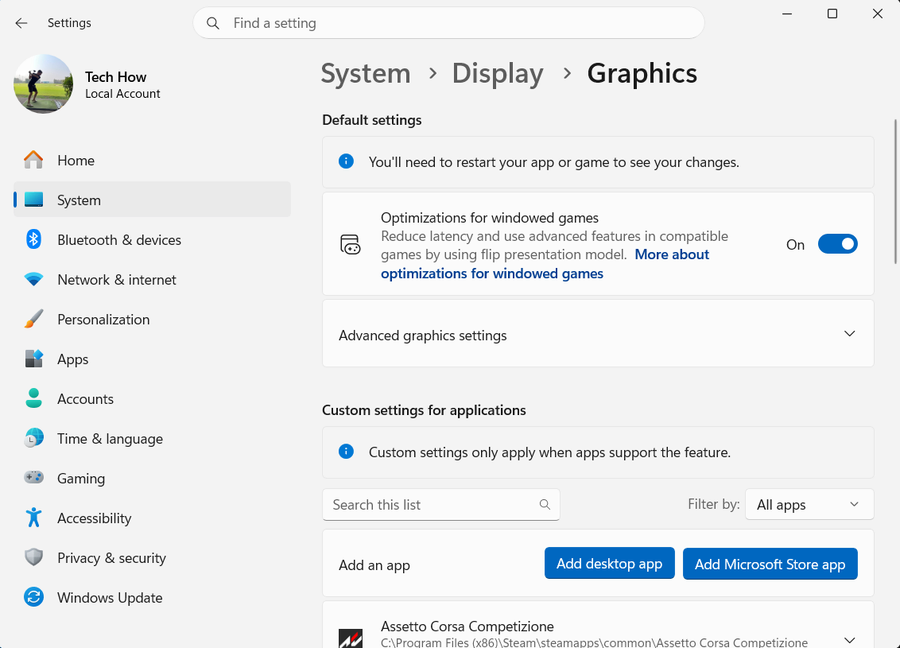
Add or select the app
Under Custom options for apps, select the app. If it is absent, choose Add desktop app > Browse and select the executable that performs the workload, not only its launcher.
Choose High performance
Select the app, choose Options, then select High performance. Confirm the GPU named below that option is NVIDIA, and select Save.
Restart and verify the app
Fully quit and reopen the app, then run the same repeatable workload. Check its GPU engine in Task Manager; on a hybrid laptop, the internal display may remain connected to Intel while NVIDIA renders the app.
Restore a missing NVIDIA option
If High performance does not name NVIDIA, install Windows driver updates or the exact laptop or PC maker's supported Intel and NVIDIA graphics package. Restart Windows and check the Graphics page again.
Video walkthrough
If it does not work
- If only Intel appears in Device Manager, do not disable it. Repair the missing NVIDIA driver or confirm that the PC actually contains an NVIDIA GPU.
- If the app ignores the preference, make sure you selected the executable that renders the app or game rather than only its launcher.
- If an external monitor still uses another adapter, check which physical port the PC maker wires to each GPU; Windows cannot reroute a fixed port.
- High performance can increase heat and battery use, especially on a laptop.
Sources and verification
Checked against official documentation on . Scope: Windows.
Microsoft and NVIDIA document that current Windows graphics preferences control per-app GPU selection and override the older NVIDIA preference.