

How to Calculate Telescope Magnification (with Examples)

One of the first things astronomers learn is how to calculate the magnification of their telescope. Magnification determines how large celestial objects appear through the eyepiece and directly influences what you can see. But many beginners get stuck asking: “Which eyepiece gives me the right magnification?”
In this article, we’ll explain the magnification formula, give worked examples, and show how Telescope Eyepiece Calculator Pro does the math instantly, while also warning you about over- or under-magnification.
The Magnification Formula
The formula for telescope magnification is straightforward: Magnification (M) = Telescope Focal Length ÷ Eyepiece Focal Length
Telescope focal length (mm): A property of the telescope’s optics, usually listed in its manual.
Eyepiece focal length (mm): Marked on the eyepiece (e.g., 25 mm, 10 mm).
Example 1:
A telescope with a 1000 mm focal length and a 25 mm eyepiece: M = 1000 ÷ 25 = 40× (You’ll see objects at 40× their apparent size.)
Example 2:
Same telescope (1000 mm) with a 10 mm eyepiece: M = 1000 ÷ 10 = 100× (You’ll get higher magnification, better for the Moon or planets, but with a narrower field of view.)
The Role of Barlow Lenses & Reducers
Accessories like Barlow lenses and reducers modify effective focal length:
A 2× Barlow doubles magnification (1000 mm → 2000 mm effective).
A 0.63× reducer shortens focal length for wider fields of view.
Example:
1000 mm telescope + 25 mm eyepiece + 2× Barlow: M = (1000 × 2) ÷ 25 = 80×
Recommended Magnification Ranges
While it’s tempting to push magnification as high as possible, practical limits are set by atmospheric seeing and telescope aperture.
Low Power (20× - 50×): Wide fields, star clusters, nebulae.
Medium Power (50× - 150×): General purpose, planets, the Moon.
High Power (150× - 300×): Double stars, planetary details, small targets (seeing-limited).
A common rule of thumb: Maximum useful magnification ≈ 2× aperture (in mm).
Example: A 100 mm refractor → ~200× maximum.
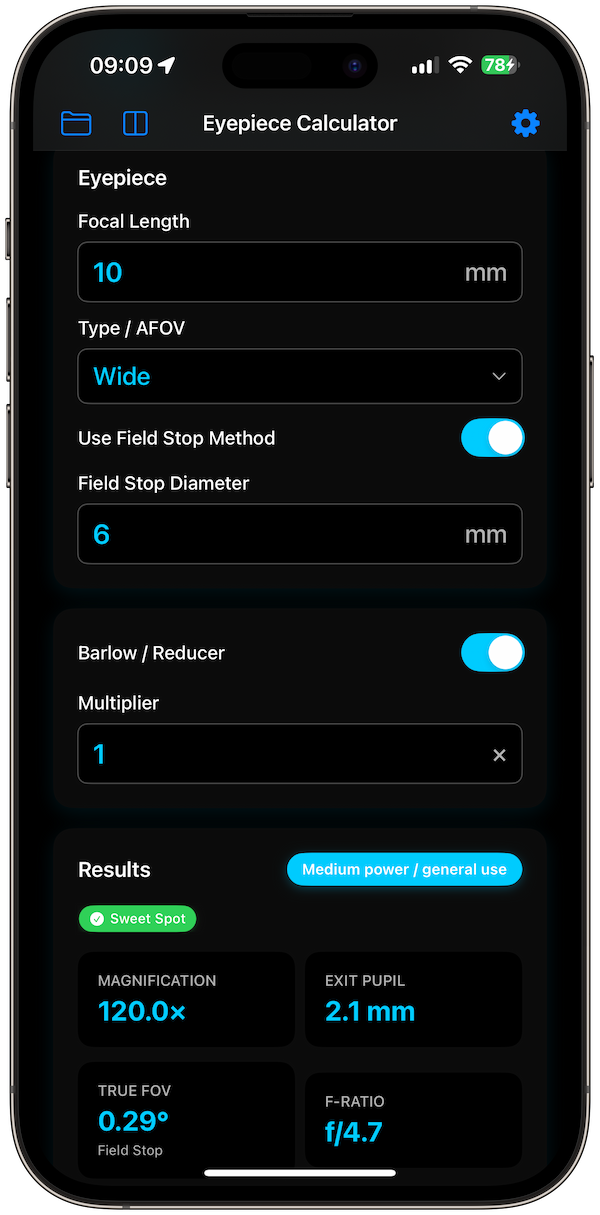
How Telescope Eyepiece Calculator Pro Makes It Easy
Instead of doing math on paper, Telescope Eyepiece Calculator Pro calculates magnification live as you type:
Enter telescope focal length + aperture → choose eyepiece focal length.
See magnification instantly, along with exit pupil and TFOV.
Add Barlow or reducer multipliers with a single tap.
Get power category badges (Low/Medium/High) so you know if you’re in the “sweet spot.”
Pro version lets you compare two eyepieces side by side and save unlimited setups.
💡 Instead of doing the math, use Telescope Eyepiece Calculator Pro for instant, accurate results, anytime, anywhere.

Final Thoughts
Magnification is one of the most important aspects of telescope use. The formula is simple, but choosing the right eyepiece for each target requires practice and planning. With Telescope Eyepiece Calculator Pro, you can skip the math and focus on the sky, confident that you’re always using the right setup.