

Irrigation Frequency: How Many Days Between Waterings?
Introduction
One of the most common questions for farmers and gardeners is: “How many days should I wait before watering again?” Getting the frequency right balances healthy crop growth with water efficiency. In this guide, we’ll explain how evapotranspiration (ETc), rainfall, soil balance, and crop needs determine irrigation intervals, and how Irrigation Calculator Pro delivers precise watering schedules instantly.
Understanding the Concepts
1. Crop Evapotranspiration (ETc)
ETc is the actual water loss via evaporation and transpiration for a specific crop. It’s calculated using: ETc = ETo × Kc
Where ETo is reference evapotranspiration (weather-driven), and Kc is the crop coefficient that adjusts for the specific crop’s growth stage.
2. Effective Rainfall (Pe)
Rainfall only partially contributes to soil moisture; “effective rainfall” (Pe) reflects what actually remains available. The FAO suggests formulas such as:
Pe = 0.8 P − 25 (if P >75 mm/month), or
Pe = 0.6 P − 10 (if P <75 mm/month)
Then,
Irrigation Need (IN) = ETc − Pe
3. Soil Water Balance & Management Allowable Depletion (MAD)
The water balance method tracks soil moisture considering water inputs (rain, irrigation) and outputs (ETc). Irrigations are scheduled before soil water depletion reaches the MAD threshold (commonly 40–50% of available water).
Calculating Your Irrigation Interval (Example)
Calculate ETc: Estimate daily ETo (via weather data) and multiply by Kc.
Subtract effective rainfall (Pe): Find net water loss.
Track soil moisture: Use previous soil water storage and daily depletion until hitting MAD.
Irrigate when needed: Once soil water reaches depletion threshold, apply irrigation.
Example:
ETo: 6 mm/day
Kc: 0.8 → ETc = 4.8 mm/day
Rain contribution: negligible
Available water capacity (AWC): 50 mm
MAD: 40% → threshold = 20 mm depletion
Water when soil loses around 20 mm → Interval ≈ 20 mm ÷ 4.8 mm/day ≈ 4 days between waterings
How Irrigation Calculator Pro Automates This
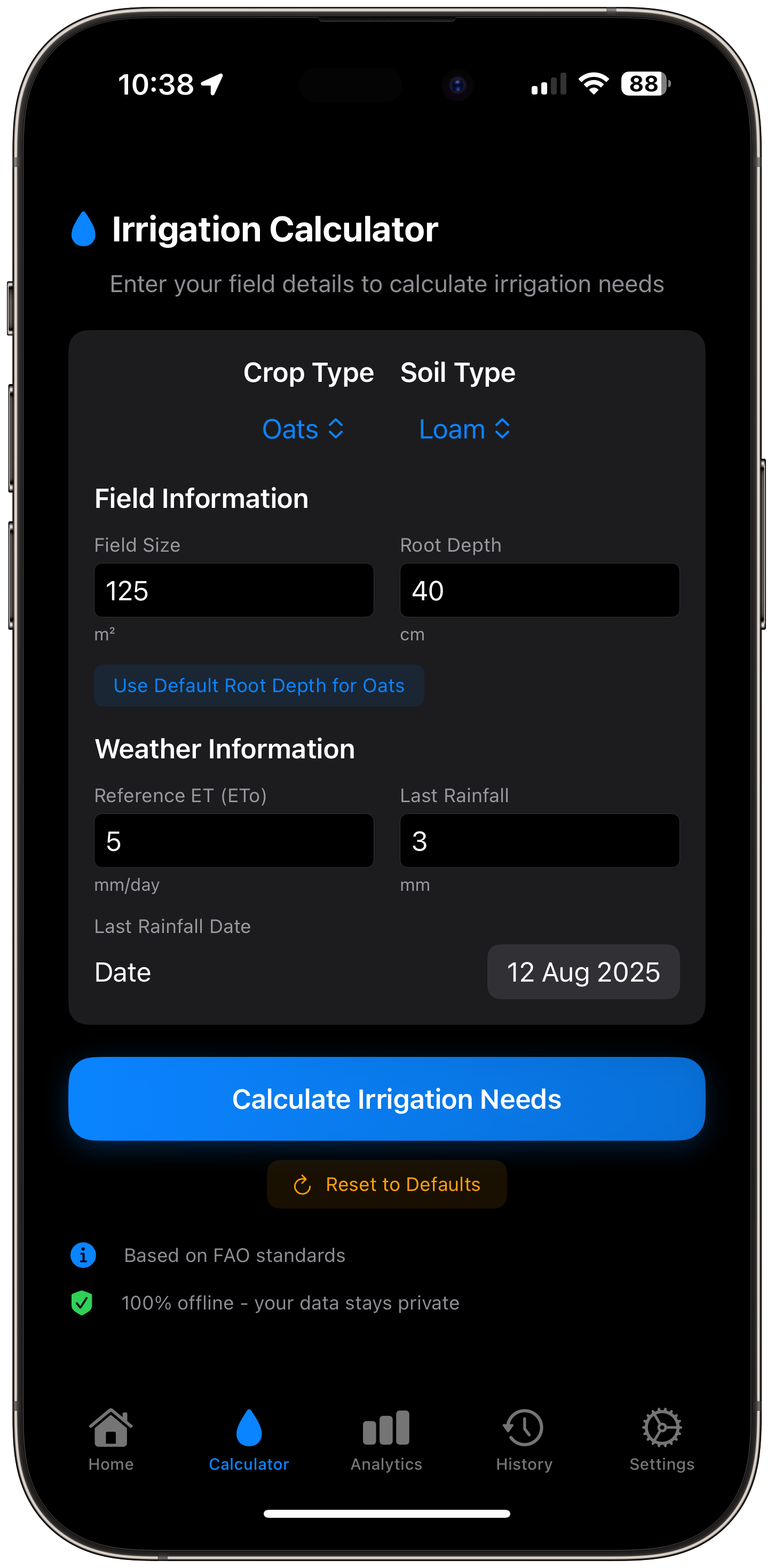
Instead of manual tracking, Irrigation Calculator Pro calculates your irrigation frequency instantly:
Integrated Weather Data: Automatically fetch ETo or use manual inputs.
Crop & Soil Defaults: Works with FAO Kc and AWC values.
Automated Balance Calculation: Considers ETc, rainfall, MAD. Then outputs days until next irrigation.
Visual Timeline & Alerts: Shows a schedule for multiple irrigation cycles.
Offline, Fast, Accurate: No internet needed once downloaded.

Benefits of Accurate Irrigation Frequency
| Benefit | Explanation |
|---|---|
| Improved Crop Health | Prevents over- or under-watering. |
| Water Savings | Irrigation only occurs when necessary. |
| Labor Efficiency | Reduces guesswork and manual planning. |
| Adaptability | Accounts for changing weather, growth stages. |
Conclusion
Determining how many days between waterings involves understanding ETc, rainfall, and soil depletion dynamics. While the basic water balance method is accurate, it’s often time-consuming. Irrigation Calculator Pro simplifies this by delivering precise irrigation frequency estimates with just a few taps, helping you optimize efficiency and yield.
References
FAO Crop Evapotranspiration (ETc = ETo × Kc): FAO Irrigation and Drainage Paper No. 56FAO method for effective rainfall and irrigation need: FAO, Irrigation Water NeedsWater balance irrigation scheduling methodology: Colorado State University ExtensionManagement Allowable Depletion guideline (40–50%): Michigan State University ExtensionCrop evapotranspiration explanation & use in scheduling – UNL CropWatch