

How to Calculate Irrigation Volume (L/m² or gal/ft²) for Any Crop
When planning irrigation, one of the most common questions is: “How much water should I apply per unit area?” Whether you’re farming, gardening, or managing a landscape, applying the right water volume is critical to crop health and water efficiency. In this article, we’ll explain the basic formula for irrigation volume in liters per square meter (L/m²) or gallons per square foot (gal/ft²), then show how Irrigation Calculator Pro makes the process much faster and easier.
The Basic Formula for Irrigation Volume
Irrigation volume is tied to the depth of water applied (usually in millimeters or inches) and the area you’re irrigating.
The formula is: Irrigation Volume = Water Depth × Area
Where:
Water Depth = the effective depth of irrigation water applied (mm or inches).
Area = the surface area (m² or ft²).
Conversions
1 mm of water applied over 1 m² = 1 liter.
1 inch of water applied over 1 ft² = 0.623 gallons.
So, for example:
If you apply 20 mm of irrigation water to 100 m²:
20 mm × 100 m² = 2,000 litersIf you apply 1 inch of water to 500 ft²:
1 inch × 500 ft² × 0.623 = 311 gallons
Adjusting for Crop, Soil, and Weather
While the formula above gives a raw estimate, real-world irrigation needs depend on:
Crop Coefficient (Kc): Different crops use different amounts of water (FAO-56 standard values).
Soil Type & Available Water Capacity (AWC): Sandy soils hold less water than loams or clays.
Weather (ETo): Evapotranspiration drives daily water demand.
Root Depth & MAD (Management Allowable Depletion): Determines how much water the crop can use before stress occurs.
These factors make manual calculations more complex, especially when scheduling irrigation over multiple days.
How Irrigation Calculator Pro Makes It Easy
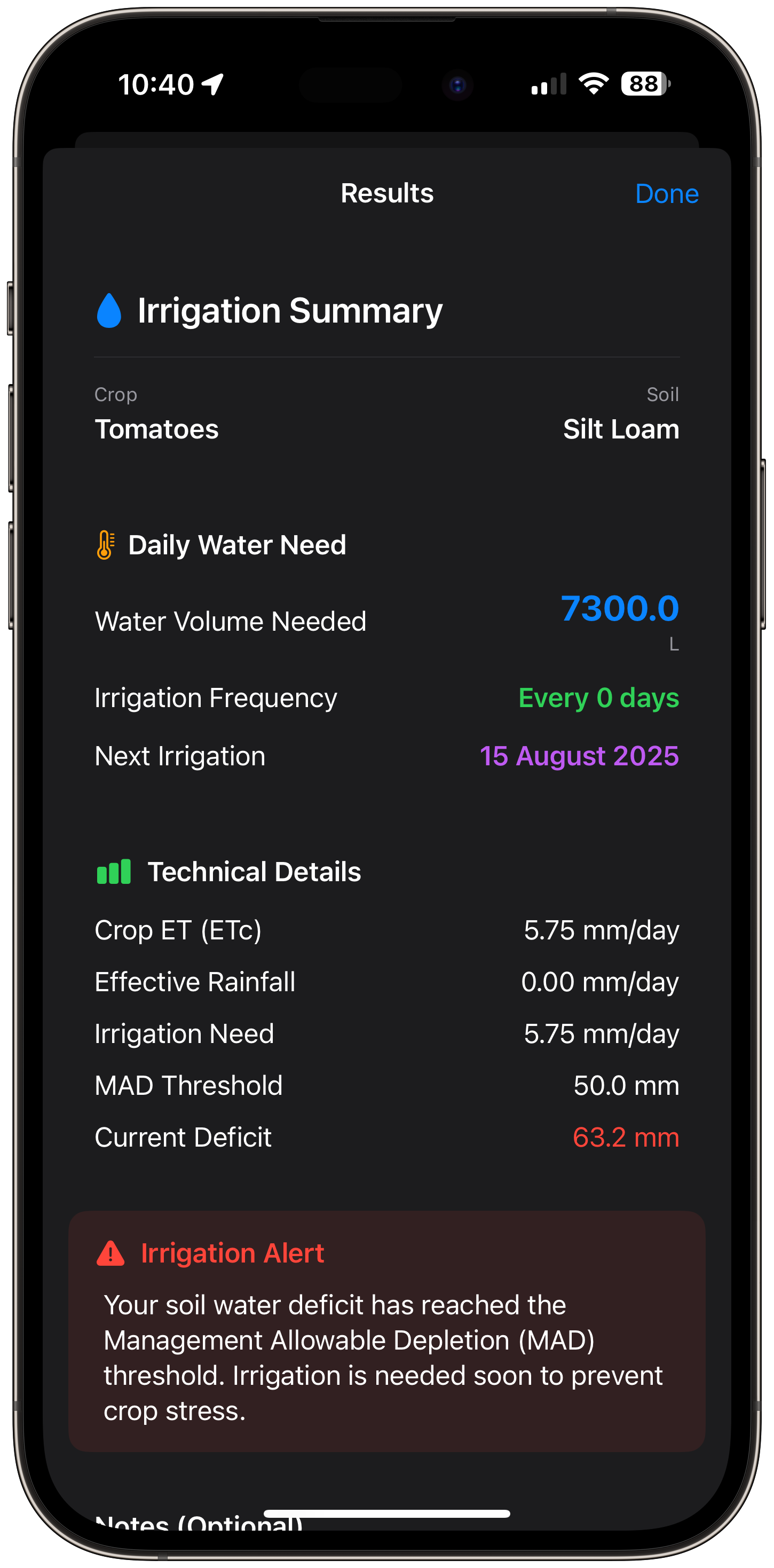
Instead of running multiple formulas, Irrigation Calculator Pro (iOS) does the full calculation instantly:
Select Your Crop & Soil Type: The app applies the correct Kc and AWC values.
Enter Field Size, ETo, and Rainfall: You can use local weather data or manual inputs.
Get Volume in L/m² or gal/ft²: Results show how much water to apply, irrigation frequency, and the next irrigation date.
Analytics Dashboard: See long-term water use, efficiency trends, and cost estimates.
History & Export: Save past runs, compare seasons, or export CSV for reports.
Whether you’re watering a tomato field, a lawn, or a maize crop, the app adapts the calculation to your conditions, removing guesswork and saving time.
Example: Tomatoes in Loam Soil
Field size: 200 m²
Soil: Loam (AWC ≈ 2.0 in/ft)
Daily ETo: 5 mm
Kc (mid-season tomato): 1.0
Daily crop water requirement = ETo × Kc = 5 mm × 1.0 = 5 mm/day
→ For 200 m²: 5 mm × 200 m² = 1,000 liters/day
Final Thoughts
Calculating irrigation volume is essential for sustainable water use and healthy crops. While the formula itself is simple, adapting it to different soils, crops, and weather requires more advanced calculations. That’s where Irrigation Calculator Pro comes in, offering farmers, gardeners, and professionals a precise, offline, and FAO-standard tool right on their iPhone.