
Windows 11 · Windows
Free Up RAM on Windows 11 Safely
Source-checked About 10 minutes
Answer
Windows manages cached memory automatically. Close memory-heavy apps, restart when necessary, reduce startup load, and use RAMMap to diagnose rather than routinely empty RAM.
Measure memory use before changing it
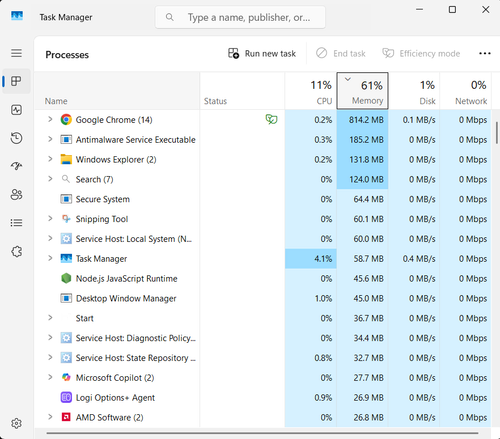
Open Task Manager with Ctrl + Shift + Esc, select Processes and sort by Memory. Record total memory pressure and the leading process during the slowdown. Save work before closing an app, and do not end an unfamiliar Windows process merely to lower the displayed percentage.
Interpret cached and available memory correctly
Windows uses otherwise idle RAM for cached data and can reclaim it when an application needs memory. A large cache is not itself a leak. Look for sustained app growth, low available memory, paging and an actual responsiveness problem instead of treating every occupied gigabyte as wasted.
Close or restart the measured cause
Close a recognized memory-heavy document, browser tab, game or application through its own interface. If a process is stuck or memory remains committed after the app closes, save all work and restart Windows. A restart is safer than repeatedly forcing standby memory empty.
Reduce unnecessary startup activity
Open Settings > Apps > Startup or Task Manager > Startup apps. Disable only optional apps that do not need to launch at sign-in, leaving security, accessibility, device-control and organization-managed software intact. Restart once and compare the same workload.
Use RAMMap for diagnosis, not a target number
Download RAMMap only from Microsoft Sysinternals when you need to inspect active, standby, file-backed and driver memory. Capture the state before taking action. Do not routinely empty lists or caches; that can discard useful cached data without fixing the process that created pressure.
Address recurring memory pressure
Update or repair an app whose memory use continually grows, install Windows updates, and run a Windows Security scan when behavior is unexplained. If ordinary supported workloads consistently exhaust physical memory, reduce the workload or consider a compatible RAM upgrade instead of using memory-cleaner software.
Video walkthrough
If it does not work
- If the PC remains slow after a restart, compare CPU, Memory and Disk in Task Manager while reproducing the problem. Escalate with the exact process, memory trend and workload when available memory stays low, paging remains heavy, or one process grows continuously; cached memory alone is not proof of a fault.
Sources and verification
Checked against official documentation on . Scope: Windows.
The current written procedure supersedes obsolete behavior or terminology shown in the preserved legacy video.